Holding companies and demergers
Splitting a Company: A Tax-Focused Guide to Demergers
 Holding companies and demergers
On this page6 sections
- What is a Demerger?
- Demergers can be motivated by several factors:
- Types of Demergers
- Statutory Demergers
- Liquidation Demergers
- Exempt Distribution Demergers
- Tax Implications of Demergers
- Capital Gains Tax (CGT)
- Stamp Duty
- Corporation Tax
- Transfer pricing and diverted profits
- VAT
- Key Considerations for a Successful Demerger
- Case Study: A Successful Statutory Demerger
- Conclusion
Key takeaways
- 1A demerger refers to the process of separating a company into two or more entities, transferring assets or shares from the parent company to a newly formed entity or existing subsidiary.
- 2There are several types of demergers that a company can choose from, each with distinct features and tax considerations:
- 3Tax considerations are at the heart of any demerger, as the way a company chooses to split its operations can significantly impact both corporate and shareholder tax liabilities.
In today’s fast-paced business world, companies often grow and diversify their operations to remain competitive and profitable. While growth is generally positive, businesses may find themselves needing to demerge, separating parts of the company to improve focus, streamline operations, or address tax concerns. This blog post explores the process of splitting a company through demergers, focusing primarily on the tax implications and the various methods available.
At ASWATAX, we specialise in advising businesses on tax-efficient demergers and restructuring. Whether it’s simplifying operations or ensuring the best outcome for shareholders, understanding the tax and legal landscape is essential for a successful demerger. You can count on our years of experience to complete a thorough job, with swift and effective communication.
What is a Demerger?
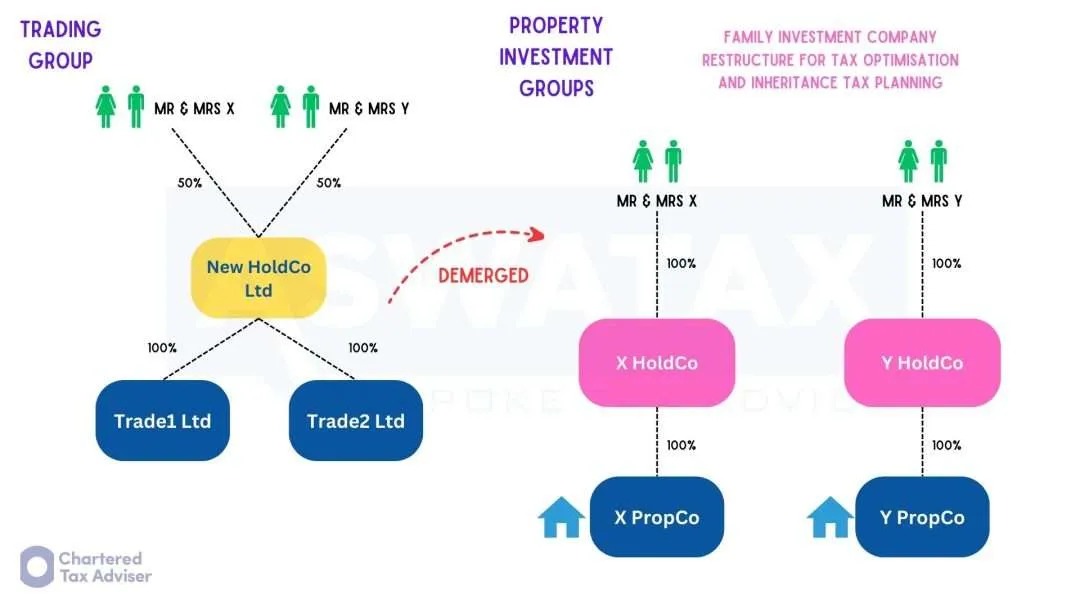
A demerger refers to the process of separating a company into two or more entities, transferring assets or shares from the parent company to a newly formed entity or existing subsidiary. This restructuring is often carried out to allow different business segments to operate independently or to offer shareholders more direct control over their investments.
Demergers can be motivated by several factors:
- Improved focus: Separating diverse operations into specialised entities may help management focus on the core business.
- Reduced complexity: Demergers can simplify the structure of a business, making it easier to manage and operate.
- Shareholder value: In some cases, splitting the company can unlock value by offering shareholders a more direct investment in specific parts of the business.
- Tax efficiency: A well-structured demerger can help optimise tax liabilities, benefiting both the company and its shareholders.
However, a demerger is a complex process, particularly from a tax perspective. It requires careful planning and execution to ensure that tax consequences are minimised.
We’ve come across several instances, including a recent one, where a business received tax advice from another firm, only for us to identify significant gaps and missed opportunities. After our thorough review, we’re pleased to say the clients are now in good hands. We share this with the utmost respect for all involved.
Types of Demergers
There are several types of demergers that a company can choose from, each with distinct features and tax considerations:
- Statutory demergers
- Liquidation demergers
- Exempt distribution demergers
Statutory Demergers
A statutory demerger is a formal method governed by the demerger rules in the Corporation Tax Act 2010 (with company law rules on distributions) and UK tax legislation. This involves distributing shares in a new company to the existing shareholders, with the aim of separating business divisions. No consideration is required, and critically, no Capital Gains Tax (CGT) is triggered for shareholders.
From a tax perspective, statutory demergers are highly advantageous, especially for shareholders, as there is no immediate tax charge. However, it’s crucial to meet specific conditions laid out by HMRC. For instance, the demerger must involve the transfer of a viable business, be carried out wholly or mainly to benefit trading activities, and tax avoidance must not be one of its main purposes. Since 26 November 2025, a stricter main purpose test also applies to share exchanges and reconstructions.
Liquidation Demergers
In a liquidation demerger, the parent company is liquidated, and its assets are transferred to a new company or companies. Shareholders receive shares in the new companies, replacing their interest in the original company.
While liquidation demergers can be useful in certain circumstances, they are less common than statutory demergers. A key tax point here is that, if structured as a scheme of reconstruction, shareholders normally have no immediate CGT, provided HMRC clearance is obtained and the main purpose test is met. A liquidation demerger may be necessary where statutory demerger conditions cannot be met.
Exempt Distribution Demergers
Exempt distribution demergers occur when the parent company distributes the shares of its subsidiaries to its shareholders without triggering CGT. This is a highly tax-efficient method if structured correctly, as no immediate tax charge arises.
The main advantage is that these demergers can be executed without significant tax liabilities for shareholders. However, it’s essential to ensure that the transaction qualifies as an exempt distribution, meaning it is carried out wholly or mainly to benefit trading activities and tax avoidance is not one of its main purposes.
A statutory demerger is a formal method governed by the demerger rules in the Corporation Tax Act 2010 (with company law rules on distributions) and UK tax legislation.
Tax Implications of Demergers
Tax considerations are at the heart of any demerger, as the way a company chooses to split its operations can significantly impact both corporate and shareholder tax liabilities.
Capital Gains Tax (CGT)
For shareholders, CGT is a crucial consideration in a demerger. Under a statutory demerger, no CGT is payable immediately, as the demerger is treated as a continuation of the investment, rather than a disposal of shares. However, if the demerger is not structured correctly, shareholders could face a CGT charge on the distribution of shares or assets.
Stamp Duty
Stamp Duty is another tax that can affect the demerger process. In certain demergers, particularly those involving the transfer of assets, Stamp Duty may be payable. It’s important to plan the demerger carefully to avoid unnecessary Stamp Duty liabilities. In some cases, relief from Stamp Duty can be claimed if the demerger meets HMRC’s qualifying conditions.
Corporation Tax
For the company itself, the tax implications of transferring assets in a demerger must be carefully considered. Corporation Tax may be due on any gains arising from the transfer of assets to a new company. This is especially important in non-statutory demergers where the transfer of assets is treated as a disposal for tax purposes.
Transfer pricing and diverted profits
Large groups should check the transfer pricing rules. For accounting periods beginning on or after 1 January 2026, Diverted Profits Tax was replaced by a charge on unassessed transfer pricing profits within corporation tax. Proper planning is necessary to avoid an unexpected charge, particularly for multinational companies considering a demerger.
VAT
For VAT purposes, a demerger may involve the transfer of a going concern, meaning that VAT is not chargeable on the transfer of assets. However, if the transfer does not qualify as a going concern, VAT could become payable. Ensuring that the demerger is structured as a transfer of a going concern is a key part of managing VAT liabilities.
Key Considerations for a Successful Demerger
While tax is an essential consideration, several other factors need to be addressed when planning and executing a demerger. Here are a few key points:
- Commercial rationale: A demerger must have a clear commercial rationale. HMRC scrutinises demergers to ensure that they are not being carried out purely for tax avoidance purposes.
- Shareholder approval: For many types of demergers, shareholder approval is required. It’s important to communicate clearly with shareholders about the benefits of the demerger and ensure that they understand any tax implications.
- Regulatory compliance: Companies undergoing a demerger must comply with all relevant regulatory requirements, including those related to tax, company law, and financial reporting.
- Long-term impact: Demergers should be planned with the long-term impact in mind, not just the immediate tax consequences. For instance, a demerger might affect the company’s ability to raise finance or impact its relationships with suppliers and customers.
Case Study: A Successful Statutory Demerger
Let’s take a live example to illustrate how a statutory demerger can be used to achieve both commercial and tax benefits.
A family-owned company with two distinct divisions—manufacturing and retail—decided to split the business through a statutory demerger. The aim was to allow the management of each division to focus more effectively on their core operations. The family members owned shares in the company, and a demerger offered a way to separate the two businesses without triggering significant tax liabilities.
After engaging with us at ASWATAX, the company chose a statutory demerger, following our initial analysis and recommendation. By transferring the retail division into a newly formed subsidiary and issuing shares to existing shareholders, the company was able to demerge the two businesses tax-efficiently. The shareholders faced no immediate CGT, and the company qualified for Stamp Duty relief.
Post-demerger, the manufacturing and retail companies operate as independent entities, allowing the family members to focus on their respective interests. Shareholders saw an increase in value as each company could now pursue growth strategies tailored to its specific market.
Conclusion
Demergers are an invaluable tool for businesses looking to streamline operations, focus on specific markets, or unlock shareholder value. However, the tax implications of a demerger are complex, and getting the structure right is critical to ensuring that the transaction is both commercially viable and tax-efficient.
At ASWATAX, we help businesses navigate the intricate tax landscape surrounding demergers, ensuring that you can split your company in the most efficient way possible. Whether you’re a growing company considering restructuring or an established business seeking to simplify operations, our tax advisory services are designed to help you achieve the best outcome.
If you’re considering a demerger or would like advice on any other tax-related matters, reach out to our expert team at ASWATAX for a consultation.
Business Owners
Want this applied to your situation?
Group structures, reliefs and exit planning for owner-managed companies, from first holding company to sale.
Go deeper on our specialist site: demergertax.co.uk
Free guide
The Holding Company Guide
When a holding company helps, how to set one up and the clearances to get first.