Property tax
Is Incorporating Your Property Portfolio Still Worth It in 2026/27?
 Property tax
On this page5 sections
- The Three Structures
- Annual Tax Comparison: Personal vs Ltd vs FIC (2026/27 rates)
- What the Numbers Show
- The Exit Problem: Where the Company Loses
- Exit Tax Comparison: Selling a Property with a £400,000 Gain
- Where the FIC Adds Value Beyond the Numbers
- So Is Incorporation Still Worth It?
- How ASWATAX Can Help
Key takeaways
- 1The comparison involves three approaches: personal ownership in the investor's own name, a standard limited company structure, and a Family Investment Company (FIC).
- 2The table shows that the company wins on annual running costs at these income levels, but by much less than many landlords expect when profits are extracted.
- 3The annual running comparison is only half the picture.
For the better part of a decade, property investors have been told that incorporating their portfolios into a limited company is the obvious answer to rising tax costs. The abolition of mortgage interest relief under Section 24, the reduction of the CGT annual exempt amount, and the widening gap between corporate and personal tax rates on investment income all pointed in the same direction. Get it into a company, the argument went, and let it grow at 25% corporation tax rather than 40% or 45% income tax.
The argument was not wrong then, and for many landlords it still holds today. But the landscape has shifted enough since 2020 that the blanket advice to incorporate needs to be properly tested rather than assumed. Dividend tax rates are higher. Corporation tax is no longer the flat 19% it was when many landlords made their decision to incorporate. The cost of extracting profits from a company has risen materially. And the exit problem, which was always the uncomfortable sequel to the incorporation conversation, has not gone away.
This blog models the three main ownership structures for a typical UK property investor at 2026/27 rates, sets out clearly where the company wins and where it does not, and identifies the clients for whom incorporation still makes compelling sense versus those for whom the numbers no longer justify the complexity.
The Three Structures
The comparison involves three approaches: personal ownership in the investor's own name, a standard limited company structure, and a Family Investment Company (FIC). The FIC is a private limited company with a carefully designed share structure that allows income and capital to be directed between family members for both income tax and IHT purposes. It is not a fundamentally different vehicle from a standard Ltd in terms of its day-to-day tax treatment, but the share structure and the IHT planning possibilities distinguish it in important ways.
For the model, we have assumed a landlord couple with three buy-to-let properties generating £85,000 gross rental income per year, £32,000 of mortgage interest, and £11,000 of other allowable expenses. Both spouses are higher-rate taxpayers on their other income, meaning any rental profit, salary, or dividend falls at 40% income tax or 35.75% dividend tax. The company pays corporation tax at 19%, because its taxable profit of £42,000 is below the £50,000 small profits threshold. This assumes the company has no associated companies; a company letting property to unconnected tenants is not a close investment-holding company, so the small profits rate is available.
Annual Tax Comparison: Personal vs Ltd vs FIC (2026/27 rates)
| Personal Ownership | Limited Company | Family Investment Co. | |
|---|---|---|---|
| Client Profile (same for all three structures) | |||
| Gross rental income | £85,000 | £85,000 | £85,000 |
| Mortgage interest (Section 24 applies personally) | £32,000 | £32,000 | £32,000 |
| Other allowable expenses | £11,000 | £11,000 | £11,000 |
| Net profit before finance costs | £74,000 | £74,000 | £74,000 |
| Tax Within the Structure | |||
| Taxable profit | £74,000 (interest not deductible under S24) | £42,000 (full interest deduction) | £42,000 (full interest deduction) |
| Income tax / CT before credit | £29,600 (40% on £74,000) | £7,980 (19% CT on £42,000) | £7,980 (19% CT on £42,000) |
| Section 24 basic rate credit (20% x £32,000) | (£6,400) | N/A | N/A |
| Net tax within structure | £23,200 | £7,980 | £7,980 |
| Net profit after structural tax | £50,800 (in personal hands) | £66,020 (inside company) | £66,020 (inside company) |
| Scenario A: Extracting £40,000 for Personal Use | |||
| Extraction method | Already personal — no further step | Dividend | Dividend to FIC shareholders |
| Dividend tax on £40,000 (35.75%, no allowance) | N/A | £14,300 | £14,300 |
| Total annual tax (structure + extraction) | £23,200 | £22,280 | £22,280 extracted; balance grows at 19% |
| Annual saving vs personal when extracting | — | Ltd saves £920 | Saves £920 on extraction; bigger advantage on retention |
| Scenario B: Retaining All Profits in Structure | |||
| Tax on retained profit | £23,200 (income tax — unavoidable) | £7,980 (CT only) | £7,980 (CT only) |
| Profit compounding after tax | £50,800 personally | £66,020 inside company | £66,020 inside company |
| Annual saving vs personal when retaining | — | £15,220 per year | £15,220 per year (plus IHT and income-split benefits) |
Assumptions: both spouses higher-rate taxpayers, no dividend allowance remaining, company at 19% CT (small profits rate; no associated companies). Extraction modelled as dividend of £40,000 to cover personal costs. Section 24 restriction modelled at full phase-in.
What the Numbers Show
The table shows that the company wins on annual running costs at these income levels, but by much less than many landlords expect when profits are extracted. The personal income tax bill is £23,200 (40% on £74,000, less the 20% basic rate credit of £6,400 on the mortgage interest). The combined corporation tax and dividend extraction cost is £22,280. When a landlord takes £40,000 out to live on, the company saves only £920 a year.
The gap widens sharply when profits are retained inside the structure. Where the landlord does not need to extract all the income each year, corporation tax of £7,980 on £42,000 of profit compares very favourably to personal income tax of £23,200 on £74,000. The annual saving on retained profits is £15,220. Over ten years, assuming stable income levels, that differential adds up to over £152,000 of additional capital accumulating inside the company relative to personal ownership. This is where the case for incorporation actually rests, and it is a strong case but only for landlords who can genuinely leave a meaningful proportion of the income inside the structure.
The Section 24 effect is central to understanding the comparison. The restriction does not simply add an arbitrary tax charge on top. It converts higher rate relief on the mortgage interest into basic rate relief only. A higher rate taxpayer loses 20 pence in the pound on every pound of mortgage interest paid. In this example that is exactly £6,400 (20% of £32,000). Inside the company, the full interest is deductible at the corporation tax rate and the restriction disappears entirely. For a highly leveraged landlord with a large mortgage relative to rental income, this difference is the dominant factor in the annual tax comparison.
The case for incorporation is not primarily an annual income tax saving on extracted profits. At current rates, extracting the income through a company saves only a little compared with personal ownership. The case rests on the compounding advantage of retaining and growing profits at 19% corporation tax (25% on larger profits), and on the long-term exit, succession, and IHT planning benefits the structure provides. If a landlord needs all the income to cover living costs, the annual numbers alone do not justify the complexity.
The table shows that the company wins on annual running costs at these income levels, but by much less than many landlords expect when profits are extracted.
The Exit Problem: Where the Company Loses
The annual running comparison is only half the picture. The other half is what happens when the landlord eventually wants to sell a property or wind down the portfolio. This is where the company structure consistently underperforms personal ownership, and it is the calculation that is most often either ignored or deferred when landlords make the initial incorporation decision.
Inside a company, a gain on disposal is subject to corporation tax at 25%. The proceeds, net of that tax, then sit inside the company. To access them personally, the landlord must extract them as a dividend, triggering dividend tax at up to 35.75% on top. The combined effect is a double tax charge on the gain that significantly exceeds the CGT rate payable on a direct personal disposal.
Exit Tax Comparison: Selling a Property with a £400,000 Gain
| Disposal Scenario (£400,000 gain) | Personal Ownership | Limited Company |
|---|---|---|
| CGT / tax on gain | £96,000 (24% residential CGT) | £100,000 (25% CT on gain) |
| Tax on extracting proceeds from company | N/A | £107,250 (35.75% dividend tax on £300,000 net) |
| Total tax on disposal and extraction | £96,000 | £207,250 |
| Additional tax cost inside company | — | £111,250 |
Assumes higher-rate taxpayer, no annual exempt amount remaining. Dividend extraction assumes 35.75% on net proceeds after CT. Personal CGT at 24% residential rate. In practice, a £300,000 dividend in one year would mostly fall in the 39.35% additional rate band, so the real cost would be higher unless extraction is spread over several years.
The double tax problem is real and significant. A £400,000 gain that costs £96,000 in CGT personally costs over £207,000 in combined taxes inside the company. The additional tax of £111,250 in this example equals about seven years of the £15,220 annual saving from retaining profits. If the landlord extracts the income instead, the annual saving is only about £920, and the extra exit cost would never be recovered.
There are partial mitigations. A company can reinvest proceeds into new properties without triggering the dividend extraction charge, deferring the personal tax indefinitely. If the landlord never needs to extract the proceeds personally, perhaps because the portfolio passes to the next generation through the company shares rather than by selling the properties first, the double tax may never crystallise in its full form. And a winding-up via a Members Voluntary Liquidation can in some circumstances convert the extracted value to a capital distribution taxed at CGT rates rather than dividend rates, improving the exit economics. But each of these routes requires planning, and none of them makes the double tax problem disappear entirely.
Where the FIC Adds Value Beyond the Numbers
Typical Structure
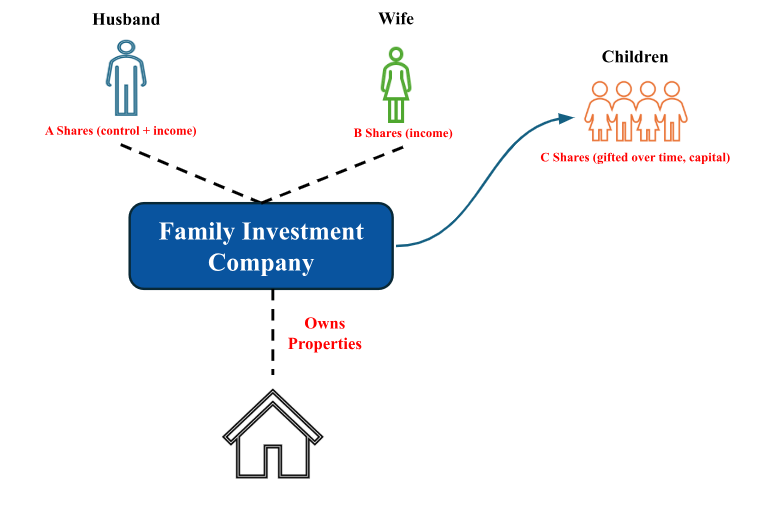
The FIC produces broadly the same in-year tax outcome as a standard limited company. Its advantage lies not in the annual running position but in three areas that the numbers in the table above do not capture.
The first is IHT planning. Shares in a FIC are not shares in a trading company and therefore do not benefit from Business Property Relief. However, the structure of the share capital, which typically separates control (ordinary shares held by the parents) from economic rights (preference or growth shares held by or gifted to children), allows the value of future growth to be removed from the parents' estate progressively without giving up control. Each gift of shares starts a seven-year PET clock. The FIC does not solve the IHT problem immediately but it provides the framework within which IHT planning becomes manageable over time.
The second is income splitting. A FIC with a carefully designed share structure allows dividends to be directed to family members with lower marginal rates, making use of their personal allowances and basic rate bands. In a standard Ltd with two equal shareholders, dividends are paid proportionally to the shareholding. In a FIC with alphabet shares, the allocation can be adjusted each year to reflect the most efficient distribution for that year's circumstances.
The third is long-term wealth accumulation. Profits retained inside the FIC grow at 19% corporation tax (25% on larger profits) rather than at the 40% or 45% that would apply if the same income were received personally. Over a long time horizon, the compounding effect of that differential is substantial. The FIC is at its best when the landlord does not need all the income to live on and is prepared to let a proportion of the profits accumulate inside the structure for the benefit of the next generation.
So Is Incorporation Still Worth It?
The honest answer is: it depends, and the key variable is how much of the income the landlord actually needs to extract each year. The broad conclusions from the corrected analysis are as follows.
- Incorporation is most compelling for: landlords who can retain a meaningful proportion of profits inside the structure each year rather than extracting everything, highly leveraged portfolios where Section 24 is biting hardest, those with a long horizon who are not approaching an exit, and those with IHT planning objectives where a FIC addresses the estate problem alongside the income tax efficiency.
- Incorporation is least compelling for: landlords who need all the rental income to meet living costs, since the annual saving almost disappears when the income is extracted (£920 a year in our example). Also weak for unencumbered or lightly mortgaged portfolios where the Section 24 advantage is small, and for those approaching a sale where the exit double tax problem dominates.
- The FIC adds specific value over a standard Ltd when: there are IHT planning objectives in play, income splitting across family members can be used to reduce the overall dividend tax cost, and there is a genuine long-term horizon with appetite to accumulate wealth inside the structure across generations.
One further point is worth making. The cost of incorporating has also changed. From 6 April 2026, incorporation relief under section 162 TCGA 1992 is no longer automatic and must be claimed. The conditions must be met, the claim must be made by the first anniversary of 31 January following the tax year of the transfer (31 January 2029 for a 2026/27 transfer), and the transaction must be structured correctly from the outset. For portfolios with large latent gains, getting this wrong means a very large CGT charge falling immediately on transfer. The cost of specialist advice at the point of incorporation is a fraction of the cost of that charge.
Stamp duty land tax is the other large cost. A transfer of properties to a company you are connected with is charged on their market value, not on the price paid (section 53 of the Finance Act 2003), normally at the higher rates for additional dwellings, which include the 5% surcharge. Some genuine, long-standing property partnerships can reduce or remove this charge under the partnership rules, but this needs careful advice. Our specialist site covers this in its guide to incorporating a property portfolio.
How ASWATAX Can Help
We work with property investors at every stage of the portfolio lifecycle, from the initial structure decision through to sale, succession, and estate planning. Whether you are considering incorporation for the first time, reviewing a structure that was put in place several years ago under a different rate environment, or approaching an exit and trying to understand the tax cost, we can model the full picture for your specific circumstances and give you a clear recommendation.
Get in touch to arrange a property portfolio review.
Property Professionals
Want this applied to your situation?
Incorporation, CGT, SDLT and capital allowances for landlords, developers and commercial property owners.
Go deeper on our specialist site: propertytaxadvisory.co.uk
Guide in progress
The Property Incorporation Guide
Whether a company suits your portfolio, and the CGT and SDLT traps to avoid.
Talk it through instead
Our The Property Incorporation Guide is being written. In the meantime, a 20-minute call with a Chartered Tax Adviser is free.
Book a free callWe reply the same working day.