


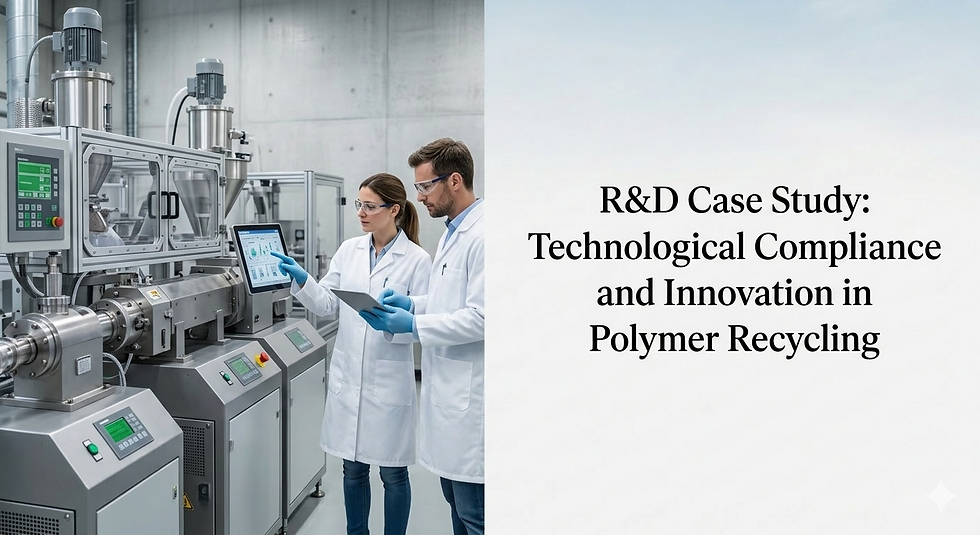
Technological Compliance and Innovation in Polymer Recycling
Personal tax planning can feel overwhelming, especially when significant wealth or complex circumstances are involved. Our experienced team specialises in helping individuals and families navigate sophisticated tax challenges with confidence and clarity.
This case study demonstrates how a UK plastics manufacturer navigated significant regulatory and supply chain challenges by undertaking systematic Research & Development (R&D), resulting in a successful tax relief claim prepared by our firm.
Client Profile and Eligibility
The client, referred to as the Polymer Manufacturing Company (PMC), is a UK-based producer of plastic sheeting, primarily recycled polyethylene terephthalate (rPET), used in the food packaging industry. The company is driven by innovation and quality, and its vision is to be ranked as the number one producer of rPET sheeting.
SME Status: For the accounting period ending 31 March 2024, PMC qualified as an SME (Small and Medium-sized Enterprise) for R&D tax relief purposes. The company employed around 25 staff and reported an approximate turnover of almost £10 million.
Qualifying Factors: PMC qualified for enhanced R&D relief because the company confirmed it was not in receipt of any subsidies or grants towards these projects. Furthermore, the company maintained full autonomy, retained ownership of intellectual property (IP), and accepted the economic and financial risk associated with the R&D projects.
The Technological R&D Projects
The R&D claim was based on four overarching projects that sought to achieve an advance in science or technology by resolving scientific or technological uncertainty.
1. Adapting to New FSA Regulations
Uncertainty: How to develop a commercially viable process and materials mix that meets new FSA regulations (effective July 2023), which prohibited the standard A-B-A structure (virgin capping layer).
PMC achieved FSA approval for their specific model of Infrared Dryer (IRD) machine through coordination with the machine manufacturer. Collaborating with the machine manufacturer resulted in the first FSA approval for the manufacturing company. PMC was able to retain the intellectual property specific to the machine and process. This provided an overall increase in knowledge and capability in the industry.
2. Dust Contamination Project
Uncertainty: Identifying the exact causes and sources of optical anomalies that created market resistance, despite the rPET meeting hygiene standards.
Uncertainty was resolved through independent microscopic inspection and analysis and the installation and manipulation of a non-standard system to monitor impurity levels in real-time. This provided an increase in overall knowledge regarding polymer recycling technology.
3. IRD System Repurposing
Uncertainty: Whether the existing Infrared Dryer (IRD), which was designed only to dry flakes, could be successfully repurposed as a cleaning device to safely remove sufficient contaminants to meet anticipated 2025 EFSA regulations.
PMC performed "Challenge Tests" in collaboration with a laboratory. Resolution was achieved through trial-and-error testing, establishing that operating the IRD between certain temperatures and a minimum of a specific amount of time was necessary to make the material suitable for food-contact applications.
4. Improving Processes due to Inferior Materials
Uncertainty: Developing new processes to efficiently remove new contaminants (like PVC and rubber) caused by material shortages, while maintaining high output quality without incurring significant capital expenditures.
PMC utilized microscopic inspection and analysis, combined with iterative refinement trials. This led to enhanced washing processes and the implementation of machinery like a colour sorting machine to resolve the uncertainty.
The Claim Preparation and Financial Summary
The success of the claim preparation relied on our systematic process, ensuring compliance with HMRC requirements and technical guidelines (CIRD manual).
1. Information Extraction and Compliance Dialogue
The process began with detailed discussions and correspondence with the client's competent professionals. This dialogue was critical for ensuring that the identified projects sought to resolve scientific or technological uncertainty and for validating that the company had maintained sufficient supporting records. There were a number of back and forths between ASWATAX and PMC where we ensured the level of information provided would hold up to HMRC scrutiny and the narrative around the projects was sufficiently demonstrated. The level of detail included on the projects needed to be able to prove that the work undertaken was non-trivial and represented an actual advance in the industry. The company’s long standing presence in the industry, especially as a forerunner, further reinforced the point that the advancement achieved needed to have industry professionals working on it to realise the outcome.
2. Cost Treatment and BEIS Alignment
We ensured that the treatment of costs adhered to the legislation (S1124 and S1126 CTA 2009).
Staff Costs: Employee time spent on R&D, including qualifying indirect activities (CIRD83000), was provided based on a fair and reasonable assessment by technical leads, applying a conservative approach when necessary.
Material Costs: Only costs for materials, software, and packaging consumed in the resolution of scientific or technological uncertainties were claimed.
Utilities: Utility costs were incurred and appropriately apportioned as a percentage of the employee costs claimed.
It was important to manage any risk associated with the claim by ensuring every cost included had ample evidence to support their inclusion. Erring on the conservative side ensures that there is no danger of overclaiming and reinforces the credibility of the submission.
3. Technical Report and AIF Submission
We created a detailed technical report covering the projects identified in the first phase. The projects descriptions went into considerable detail around the existing industry practices, followed by the advancement sought. An important aspect of the report were the sections around uncertainties and their resolution. With R&D, there has to be some degree of uncertainty around the work involved to demonstrate the work undertaken is indeed leading to a true advancement.
Once the textual aspect of the report was concluded, we move on to the numerical analysis. The numbers provided were arranged and summarised, giving a total R&D cost per project. Using these finalised figures, we were able to present the client with an expected tax saving once the R&D tax credits were awarded.
The R&D Technical Report was reviewed and approved by PMC management, supporting the final claim figures submitted to HMRC via the Additional Information Form (AIF).
The approximate qualifying expenditure for the period was:
Total R&D Costs Claimed: Over £600,000.
Around £175,000 of employee costs
£400,000 of consumables
£40,000 of utilities
This case study confirms how stringent external regulatory drivers (FSA/EFSA) and challenging supply chain dynamics can necessitate complex, qualifying R&D activity, which, when properly documented and aligned with BEIS guidelines, results in significant tax relief for the client.
What to expect from this Insight
This case study demonstrates how a UK plastics manufacturer navigated significant regulatory and supply chain challenges by undertaking systematic Research & Development (R&D), resulting in a successful tax relief claim prepared by our firm.
Client Profile and Eligibility
The client, referred to as the Polymer Manufacturing Company (PMC), is a UK-based producer of plastic sheeting, primarily recycled polyethylene terephthalate (rPET), used in the food packaging industry. The company is driven by innovation and quality, and its vision is to be ranked as the number one producer of rPET sheeting.
SME Status: For the accounting period ending 31 March 2024, PMC qualified as an SME (Small and Medium-sized Enterprise) for R&D tax relief purposes. The company employed around 25 staff and reported an approximate turnover of almost £10 million.
Qualifying Factors: PMC qualified for enhanced R&D relief because the company confirmed it was not in receipt of any subsidies or grants towards these projects. Furthermore, the company maintained full autonomy, retained ownership of intellectual property (IP), and accepted the economic and financial risk associated with the R&D projects.
The Technological R&D Projects
The R&D claim was based on four overarching projects that sought to achieve an advance in science or technology by resolving scientific or technological uncertainty.
1. Adapting to New FSA Regulations
Uncertainty: How to develop a commercially viable process and materials mix that meets new FSA regulations (effective July 2023), which prohibited the standard A-B-A structure (virgin capping layer).
PMC achieved FSA approval for their specific model of Infrared Dryer (IRD) machine through coordination with the machine manufacturer. Collaborating with the machine manufacturer resulted in the first FSA approval for the manufacturing company. PMC was able to retain the intellectual property specific to the machine and process. This provided an overall increase in knowledge and capability in the industry.
2. Dust Contamination Project
Uncertainty: Identifying the exact causes and sources of optical anomalies that created market resistance, despite the rPET meeting hygiene standards.
Uncertainty was resolved through independent microscopic inspection and analysis and the installation and manipulation of a non-standard system to monitor impurity levels in real-time. This provided an increase in overall knowledge regarding polymer recycling technology.
3. IRD System Repurposing
Uncertainty: Whether the existing Infrared Dryer (IRD), which was designed only to dry flakes, could be successfully repurposed as a cleaning device to safely remove sufficient contaminants to meet anticipated 2025 EFSA regulations.
PMC performed "Challenge Tests" in collaboration with a laboratory. Resolution was achieved through trial-and-error testing, establishing that operating the IRD between certain temperatures and a minimum of a specific amount of time was necessary to make the material suitable for food-contact applications.
4. Improving Processes due to Inferior Materials
Uncertainty: Developing new processes to efficiently remove new contaminants (like PVC and rubber) caused by material shortages, while maintaining high output quality without incurring significant capital expenditures.
PMC utilized microscopic inspection and analysis, combined with iterative refinement trials. This led to enhanced washing processes and the implementation of machinery like a colour sorting machine to resolve the uncertainty.
The Claim Preparation and Financial Summary
The success of the claim preparation relied on our systematic process, ensuring compliance with HMRC requirements and technical guidelines (CIRD manual).
1. Information Extraction and Compliance Dialogue
The process began with detailed discussions and correspondence with the client's competent professionals. This dialogue was critical for ensuring that the identified projects sought to resolve scientific or technological uncertainty and for validating that the company had maintained sufficient supporting records. There were a number of back and forths between ASWATAX and PMC where we ensured the level of information provided would hold up to HMRC scrutiny and the narrative around the projects was sufficiently demonstrated. The level of detail included on the projects needed to be able to prove that the work undertaken was non-trivial and represented an actual advance in the industry. The company’s long standing presence in the industry, especially as a forerunner, further reinforced the point that the advancement achieved needed to have industry professionals working on it to realise the outcome.
2. Cost Treatment and BEIS Alignment
We ensured that the treatment of costs adhered to the legislation (S1124 and S1126 CTA 2009).
Staff Costs: Employee time spent on R&D, including qualifying indirect activities (CIRD83000), was provided based on a fair and reasonable assessment by technical leads, applying a conservative approach when necessary.
Material Costs: Only costs for materials, software, and packaging consumed in the resolution of scientific or technological uncertainties were claimed.
Utilities: Utility costs were incurred and appropriately apportioned as a percentage of the employee costs claimed.
It was important to manage any risk associated with the claim by ensuring every cost included had ample evidence to support their inclusion. Erring on the conservative side ensures that there is no danger of overclaiming and reinforces the credibility of the submission.
3. Technical Report and AIF Submission
We created a detailed technical report covering the projects identified in the first phase. The projects descriptions went into considerable detail around the existing industry practices, followed by the advancement sought. An important aspect of the report were the sections around uncertainties and their resolution. With R&D, there has to be some degree of uncertainty around the work involved to demonstrate the work undertaken is indeed leading to a true advancement.
Once the textual aspect of the report was concluded, we move on to the numerical analysis. The numbers provided were arranged and summarised, giving a total R&D cost per project. Using these finalised figures, we were able to present the client with an expected tax saving once the R&D tax credits were awarded.
The R&D Technical Report was reviewed and approved by PMC management, supporting the final claim figures submitted to HMRC via the Additional Information Form (AIF).
The approximate qualifying expenditure for the period was:
Total R&D Costs Claimed: Over £600,000.
Around £175,000 of employee costs
£400,000 of consumables
£40,000 of utilities
This case study confirms how stringent external regulatory drivers (FSA/EFSA) and challenging supply chain dynamics can necessitate complex, qualifying R&D activity, which, when properly documented and aligned with BEIS guidelines, results in significant tax relief for the client.
Ready to Discuss Your Personal Tax Situation?
Get in touch with our team today to arrange your initial consultation. We’ll take the time to understand your circumstances and explain how we can help you achieve your tax and financial planning goals.

Prefer to Talk First?
If you need more information about our services before we get started, we’re here to answer all your burning questions. Simply, request a call back today and we’ll get back to you shortly.

.jpg)



Trusted by 300+ clients across the UK and internationally | HMRC clearance success rate: 100%+ | Inheritance tax savings £100m+ |
