


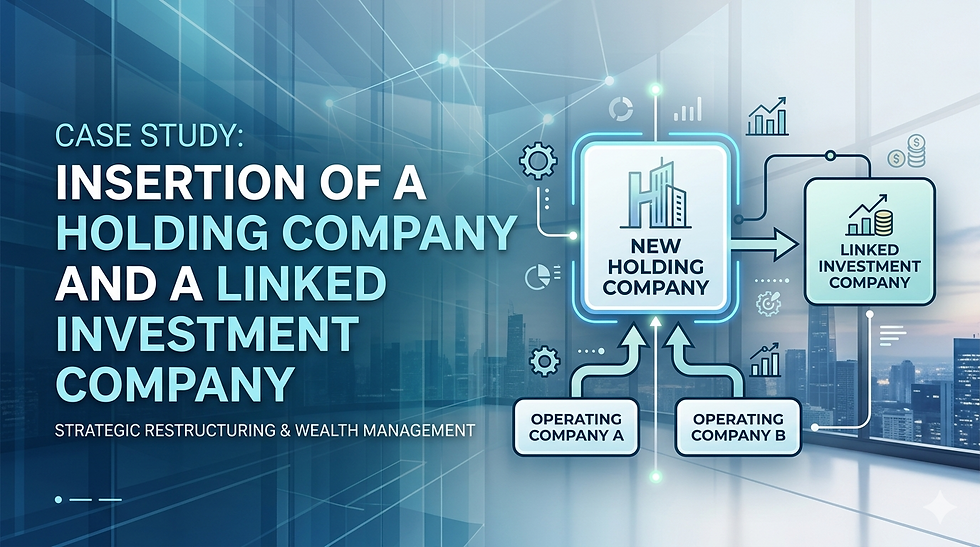
Insertion of a Holding Company and a Linked Investment Company
Personal tax planning can feel overwhelming, especially when significant wealth or complex circumstances are involved. Our experienced team specialises in helping individuals and families navigate sophisticated tax challenges with confidence and clarity.
Our client operated three relatively newly incorporated companies within a developing property and holiday-let business. Each entity had been set up to carry out a distinct activity:
A property management company, responsible for tenant liaison, maintenance coordination etc.
A property-trading company, acquiring and selling real estate.
An FHL company, owning and operating furnished holiday accommodation.
Although the businesses were commercially connected, they had been incorporated individually and without a long-term structural plan. At this early stage, the companies had minimal trading history, no subsidiaries and nothing already built up that could be a potential issue when restructuring. This created a valuable opportunity: the client could implement a robust structure before the business grew.
The client recognised that waiting until the companies matured would make restructuring more difficult, more expensive and potentially tax inefficient. The objective was therefore to establish a clean and risk managed group structure at the outset, ensuring that future expansion could take place within a coherent framework.
Initial Consideration: Incorporating a New FHL Operating Company
During early meetings with the client, we considered incorporating a new FHL operating company to sit beneath a holding company which would in turn be beneath the existing FHL company. Under this model:
The existing FHL company would retain ownership of the holiday-let properties.
The new FHL company would lease those properties and run the operational FHL trade.
This would have created a clean separation between:
property-owning FHL entity, and
operational FHL trading entity
This structure is often used to isolate trading risk, simplify VAT treatment and prepare for future expansion. It was a credible option and aligned with the client’s long-term ambitions.
With the existing companies already in place, we decided not to go ahead with this structure from the beginning and instead work with the existing companies to set up the structure. Once that base was completed, the additional trading company could then be incorporated with the holding company directly holding 100% of the shares from the outset.
Refined Structure Implemented
The final structure was designed to give the client the benefits of a group before the business reached a stage where restructuring would be more complex or costly.
1. A New Holding Company (HoldCo)
A new holding company was incorporated to sit above the property management and property trading companies. This consolidated ownership of the core property activities and created a formal group structure that reflected how the portfolio would be managed as it grew.
The insertion of the company qualified for tax neutral treatment. Under TCGA s135, the share for share exchange was not treated as a disposal and no capital gains tax was payable on the exchange. Additionally, as there was a mirror image in the exchange, the transaction qualified for stamp duty relief, meaning the insertion of the holding company didn’t come with any tax bills.
2. The Existing FHL Company Positioned as a Linked Investment Company (LIC)
Instead of incorporating a new FHL operating company, the existing FHL company was repositioned as a Linked Investment Company, acquiring a 26% shareholding in HoldCo.
This structure:
preserved the commercial separation between trading and investment activities
avoided unnecessary restructuring steps
allowed the FHL company to participate in group growth
enabled profits to be reinvested into the wider group without personal extraction
This early-stage structure ensures that as the business grows, the group can scale without needing further disruptive reorganisations.
Prior to implementing the structure, we reached out to HMRC to obtain clearance on the impending transactions and to convey the restructuring was being undergone for bona fide commercial reasons. Once clearance was granted, we moved forward with the implementation.
Implementation Steps
Step 1 - Share Allotments and Consolidation
The share capital of the relevant companies was increased to create a cleaner, more flexible capital structure. One of the companies only had a singular share from incorporation. For general planning purposes, a share capital of at least 100 is preferable. The other subsidiary had been incorporated with 1,000 shares. To maintain some consistency, we decided on 1,000 as the number of shares in each company before the share exchanges. This ensured that the reorganisation (current and any future ones) and dividend planning could be carried out more efficiently.
Step 2 - Share-for-Share Exchange to Insert HoldCo
The new holding company acquired 100% of the shares in the property management and property trading companies. The consideration was satisfied by issuing shares in the holding company with identical rights to the shares previously held.
Step 3 - Reclassification of Shares in HoldCo
The holding company’s shares were reclassified into A shares (74%) and B shares (26%). This created the framework for the FHL company to be inserted as a Linked Investment Company.
Step 4 – Share for Share Exchange with the LIC
The FHL company acquired 26% of the holding company’s share capital in exchange for transferring the B shares. This positioned the FHL company as a Linked Investment Company with a minority interest in the group. As the class of shares being exchanged was not the same, stamp duty was payable on this aspect of the reorganisation.
Commercial Outcomes
1. A future proof structure implemented at the right time
Because the companies were still young, the restructure could be implemented cleanly, without the complications that arise once assets, profits or third-party investors are involved.
2. Avoidance of future tax and administrative complexity
By restructuring early, the client avoided:
high share valuations
the need to transfer mature assets
the risk of triggering tax liabilities
the administrative burden of restructuring a larger group
3. Clear, streamlined ownership
The holding company consolidates ownership into a single entity, providing a clear structure that aligns with day to day operations.
4. Efficient reinvestment of profits
As a Linked Investment Company, the FHL company can reinvest profits into new properties without having to personally extract funds.
5. Succession ready framework
The structure provides a flexible platform for future changes in ownership.
Conclusion
By implementing the restructure at an early stage (and refining the plan to avoid unnecessary complexity) the client secured a clean and robust structure. The insertion of a holding company and the creation of a linked investment company has provided a platform that reflects the commercial reality of how the business will operate as it expands.
What to expect from this Insight
Our client operated three relatively newly incorporated companies within a developing property and holiday-let business. Each entity had been set up to carry out a distinct activity:
A property management company, responsible for tenant liaison, maintenance coordination etc.
A property-trading company, acquiring and selling real estate.
An FHL company, owning and operating furnished holiday accommodation.
Although the businesses were commercially connected, they had been incorporated individually and without a long-term structural plan. At this early stage, the companies had minimal trading history, no subsidiaries and nothing already built up that could be a potential issue when restructuring. This created a valuable opportunity: the client could implement a robust structure before the business grew.
The client recognised that waiting until the companies matured would make restructuring more difficult, more expensive and potentially tax inefficient. The objective was therefore to establish a clean and risk managed group structure at the outset, ensuring that future expansion could take place within a coherent framework.
Initial Consideration: Incorporating a New FHL Operating Company
During early meetings with the client, we considered incorporating a new FHL operating company to sit beneath a holding company which would in turn be beneath the existing FHL company. Under this model:
The existing FHL company would retain ownership of the holiday-let properties.
The new FHL company would lease those properties and run the operational FHL trade.
This would have created a clean separation between:
property-owning FHL entity, and
operational FHL trading entity
This structure is often used to isolate trading risk, simplify VAT treatment and prepare for future expansion. It was a credible option and aligned with the client’s long-term ambitions.
With the existing companies already in place, we decided not to go ahead with this structure from the beginning and instead work with the existing companies to set up the structure. Once that base was completed, the additional trading company could then be incorporated with the holding company directly holding 100% of the shares from the outset.
Refined Structure Implemented
The final structure was designed to give the client the benefits of a group before the business reached a stage where restructuring would be more complex or costly.
1. A New Holding Company (HoldCo)
A new holding company was incorporated to sit above the property management and property trading companies. This consolidated ownership of the core property activities and created a formal group structure that reflected how the portfolio would be managed as it grew.
The insertion of the company qualified for tax neutral treatment. Under TCGA s135, the share for share exchange was not treated as a disposal and no capital gains tax was payable on the exchange. Additionally, as there was a mirror image in the exchange, the transaction qualified for stamp duty relief, meaning the insertion of the holding company didn’t come with any tax bills.
2. The Existing FHL Company Positioned as a Linked Investment Company (LIC)
Instead of incorporating a new FHL operating company, the existing FHL company was repositioned as a Linked Investment Company, acquiring a 26% shareholding in HoldCo.
This structure:
preserved the commercial separation between trading and investment activities
avoided unnecessary restructuring steps
allowed the FHL company to participate in group growth
enabled profits to be reinvested into the wider group without personal extraction
This early-stage structure ensures that as the business grows, the group can scale without needing further disruptive reorganisations.
Prior to implementing the structure, we reached out to HMRC to obtain clearance on the impending transactions and to convey the restructuring was being undergone for bona fide commercial reasons. Once clearance was granted, we moved forward with the implementation.
Implementation Steps
Step 1 - Share Allotments and Consolidation
The share capital of the relevant companies was increased to create a cleaner, more flexible capital structure. One of the companies only had a singular share from incorporation. For general planning purposes, a share capital of at least 100 is preferable. The other subsidiary had been incorporated with 1,000 shares. To maintain some consistency, we decided on 1,000 as the number of shares in each company before the share exchanges. This ensured that the reorganisation (current and any future ones) and dividend planning could be carried out more efficiently.
Step 2 - Share-for-Share Exchange to Insert HoldCo
The new holding company acquired 100% of the shares in the property management and property trading companies. The consideration was satisfied by issuing shares in the holding company with identical rights to the shares previously held.
Step 3 - Reclassification of Shares in HoldCo
The holding company’s shares were reclassified into A shares (74%) and B shares (26%). This created the framework for the FHL company to be inserted as a Linked Investment Company.
Step 4 – Share for Share Exchange with the LIC
The FHL company acquired 26% of the holding company’s share capital in exchange for transferring the B shares. This positioned the FHL company as a Linked Investment Company with a minority interest in the group. As the class of shares being exchanged was not the same, stamp duty was payable on this aspect of the reorganisation.
Commercial Outcomes
1. A future proof structure implemented at the right time
Because the companies were still young, the restructure could be implemented cleanly, without the complications that arise once assets, profits or third-party investors are involved.
2. Avoidance of future tax and administrative complexity
By restructuring early, the client avoided:
high share valuations
the need to transfer mature assets
the risk of triggering tax liabilities
the administrative burden of restructuring a larger group
3. Clear, streamlined ownership
The holding company consolidates ownership into a single entity, providing a clear structure that aligns with day to day operations.
4. Efficient reinvestment of profits
As a Linked Investment Company, the FHL company can reinvest profits into new properties without having to personally extract funds.
5. Succession ready framework
The structure provides a flexible platform for future changes in ownership.
Conclusion
By implementing the restructure at an early stage (and refining the plan to avoid unnecessary complexity) the client secured a clean and robust structure. The insertion of a holding company and the creation of a linked investment company has provided a platform that reflects the commercial reality of how the business will operate as it expands.
Ready to Discuss Your Personal Tax Situation?
Get in touch with our team today to arrange your initial consultation. We’ll take the time to understand your circumstances and explain how we can help you achieve your tax and financial planning goals.

Prefer to Talk First?
If you need more information about our services before we get started, we’re here to answer all your burning questions. Simply, request a call back today and we’ll get back to you shortly.

.jpg)



Trusted by 300+ clients across the UK and internationally | HMRC clearance success rate: 100%+ | Inheritance tax savings £100m+ |
